
.png)
Inside Aperture: How FLOCO Music Is Cutting Music-Video Costs by Up to 96% Without Cutting Human Talent
- FLOCO Public Relations

- 11 minutes ago
- 6 min read

FLOCO MotionWorks is combining practical effects, CGI, AI-assisted production, and a modern reimagining of yellow-screen compositing to give independent artists access to professional-grade music videos.
Music videos have always presented independent artists with a difficult choice. Either invest tens of thousands of dollars in a conventional production, accept something visibly limited by its budget, or release the music without the visual storytelling it deserves.
FLOCO Music is building a fourth option.
We call it Aperture: a layered production system that brings real performers, physical props, practical special effects, CGI, animation, and AI-assisted augmentation tools together within one integrated workflow.
Aperture is not a filter, a single application, or an automated video generator. It is a carefully orchestrated system of overlapping media. Each element does the work it performs best:
Real performers provide personality, emotion, movement, and human presence.
Physical sets, costumes, props, and practical effects give scenes tangible weight.
CGI expands environments and creates elements that would be impractical, impossible, super expensive, or unsafe to film physically.
AI-assisted tools support transitions, environmental augmentation, continuity, cleanup, and selected visual transformations.
Human directors, editors, artists, and technicians determine how every layer fits together.
The result is a symphony of mixed media capable of producing professional-grade music videos at a fraction of conventional production costs. Our early internal comparisons indicate potential savings of up to 96 percent against a traditionally outsourced production of comparable scope.
Aperture was never designed to remove human talent from filmmaking.
The performances remain human. The creative direction remains human. The sets, props, costumes, editing decisions, and final artistic judgment remain guided by people.
Ai is simply another instrument within a much larger orchestra.
For a small independent company with limited financial resources, these tools make the difference between producing a full music video and leaving another song buried beneath a static visualizer.
They allow FLOCO Music to invest in visual storytelling without taking out loans, exhausting production budgets, or placing the company’s financial stability at risk.
Saving money should not require removing the soul from the work.
Our earliest production tests relied on conventional green-screen compositing. Green screen remains a proven and powerful filmmaking tool, but achieving clean results can require controlled lighting, specialized equipment, and experienced compositing artists.
Hair became our greatest obstacle.
During an earlier character-driven production test, green spill contaminated the fine edges of an actress’s hair so severely that a CGI artist had to reconstruct portions of it digitally. Reflective props, translucent materials, costumes, and overlapping visual effects created additional problems. The footage could be repaired, but the time and labor required undermined the affordability we were trying to achieve. Furthermore the end result looked very artificial and well Ai, despite no Ai being used to make it.
That experience sent us looking backward through film history for a better way forward.
Reimagining the Yellow-Screen Process
At the center of Aperture is FLOCO MotionWorks’ modern adaptation of the historic sodium-vapor process, commonly called “yellow screen.”
The original process used a white backdrop illuminated by narrow-spectrum sodium-yellow light. A specialized beam-splitting prism captured the live-action image and a highly accurate matte simultaneously. This allowed filmmakers to preserve difficult details such as fine hair, motion blur, soft edges, and translucent materials.
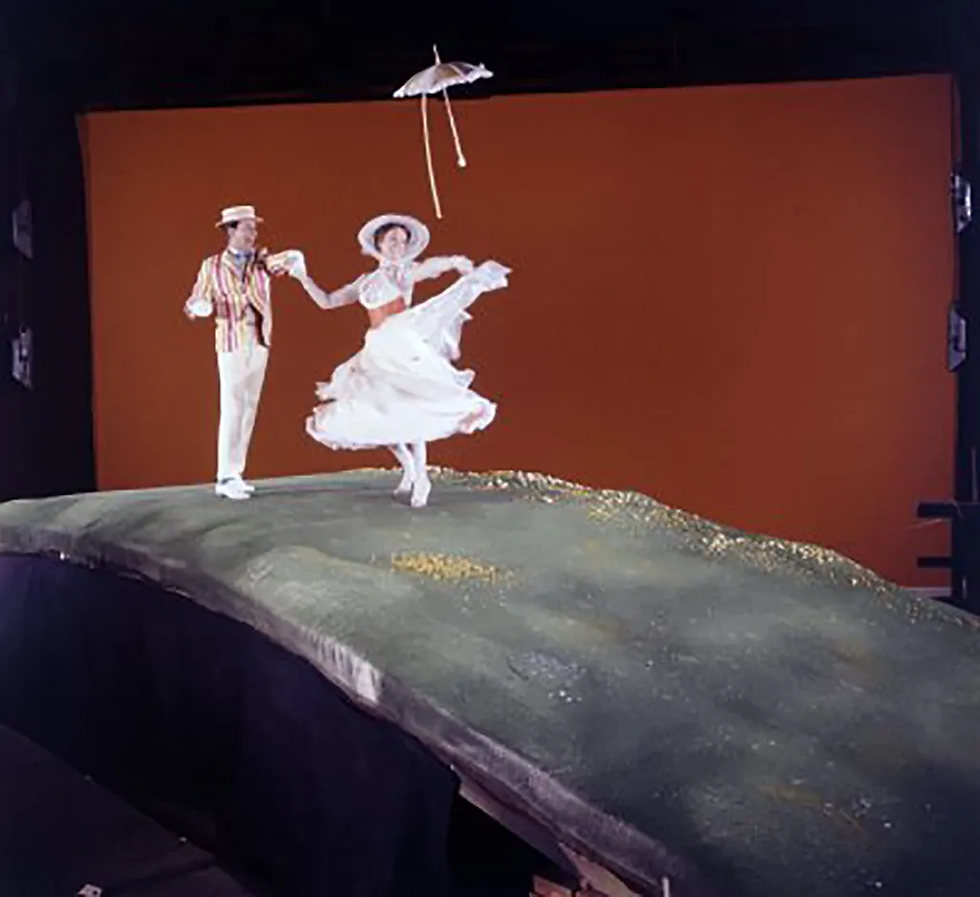
Disney Legend Ub Iwerks pioneered the process at Walt Disney Productions during the 1950s. It became an essential part of the visual-effects work on Mary Poppins and several other films. According to the Walt Disney Archives, only three of the specialized prisms were produced.
The system did not disappear overnight, but it gradually fell out of common production as competing compositing methods improved and the specialized hardware became increasingly rare. Today the "yellow screen" tech is lost to history and no manuals or guides exist on how to replicate it.
Aperture is not a one-for-one restoration of that original photochemical process. We are studying its underlying principles and rebuilding them for a modern digital workflow using surviving technical information, published histories, firsthand accounts, repeated experimentation, and newly constructed equipment.
The objective is straightforward: preserve the difficult edges and natural details that make a human performer look human while reducing the technical cleanup normally required in postproduction.
Building FLOCO MotionWorks in Palo Alto
Development of Aperture is currently taking place within contributed production space in Palo Alto, California. The facility has been offered to FLOCO Media at no cost by a supporter who shares our interest in transforming the underlying technology into a reliable, practical filmmaking system once again. Currently we are at the very start of what is schedule to be a 4 year research endeavor to develop a functional modern take on Walt Disney's long lost yellow screen secrets.
This space is becoming the working foundation of FLOCO MotionWorks, our film-production and animation division.
There, our team can test lighting configurations, calibrate equipment, construct physical elements, refine compositing methods, and identify failures before they become expensive production problems.
Aperture is already functional, but it is not finished—and we believe that distinction matters. This is an evolving production system being tested through real projects rather than a polished technology announcement built around hypothetical demonstrations.
What “Doom Buggy” Taught Us
The first complete music video produced through the developing Aperture workflow is “Doom Buggy” by Allie Cat & The Strays, released through Wicked Whispers.
One of the video’s most ambitious sequences transforms Allie Cat from her human form into a towering werecat. The effect begins with tangible elements—a live performer and a real Victorian couch—then layers in a CGI environment, additional digital effects, and a full AI-assisted augmentation pass. Together, those components create a convincing hybrid transformation that, based on conventional studio pricing, would likely have cost $3,000 or more as a standalone sequence.


The visual transformation worked, but combining all four layers disrupted portions of the performer’s mouth movement and created synchronization problems with the recorded track. A fully CGI or entirely synthetic sequence would have been easier to control, but it also would have abandoned the mixed-media approach that gives Aperture its character.
That is exactly the kind of production problem this development program is intended to solve.
We have also learned that precise on-camera lip-syncing—particularly when creating new footage for songs recorded years earlier—is a specialized performance discipline. Aperture must support performers through stronger playback rehearsals, better shot planning, carefully selected camera angles, improved synchronization tools, and editing choices designed around their strengths.
Technology should serve the performer, not ask the performer to become a technician.
You can watch “Doom Buggy” on the Wicked Whispers YouTube channel. The song appears on Wicked Beats (Volume II) and is available through Spotify and other major music services.
The Next Aperture Production
The FLOCO MotionWorks team and our music talent are already back in the studio developing the second full Aperture production: “Killer Klowns.”
We are currently targeting its release within the next one to two weeks.
FLOCO Music also has a substantial catalog of songs—some dating to 2019—that have never received full-length music videos. That backlog gives MotionWorks fertile ground on which to test, refine, and expand Aperture throughout the coming year.
Every production will teach us something new. Every failure will become another technical problem to solve. Every improvement will make the next video stronger, faster, and more affordable.
A New Production Model for Independent Music
Our purpose is not to imitate a massive studio with a collection of inexpensive shortcuts. It is to create a sustainable production model specifically for independent music and film production. We chose music videos rather than short films because music videos, even tame ones, combine so many medium elements that it will give our research more room to learn and grow rather than a short film that uses slow controlled scenes.
Aperture allows us to preserve human performance, practical craftsmanship, and creative direction while using modern tools to overcome the financial barriers that keep independent artists from producing ambitious visual work.
More affordable production means more songs can become films. More artists can receive the visual storytelling their work deserves. More creative risks can be taken without wagering the future of the company on a single video.
The tools may be changing, but the heart of filmmaking remains where it has always belonged: with human beings telling stories.
Follow FLOCO Media for production updates, behind-the-scenes reports, and future developments from FLOCO MotionWorks and the Aperture system.


Comments